Math Fact 1
Restarting because yesterday I didn't learn any new math.

Today I was mostly working on my other post about art that will drop tomorrow for real this time (I have the first draft ready).
So I will talk about a result in this paper I downloaded because it had local to global in the title. Little did I know that it was about measure theory…
The paper was pretty advanced and I had no understand of the context it was in, so my goal was just to understand the motivating theorem. This is the behemoth of a theorem
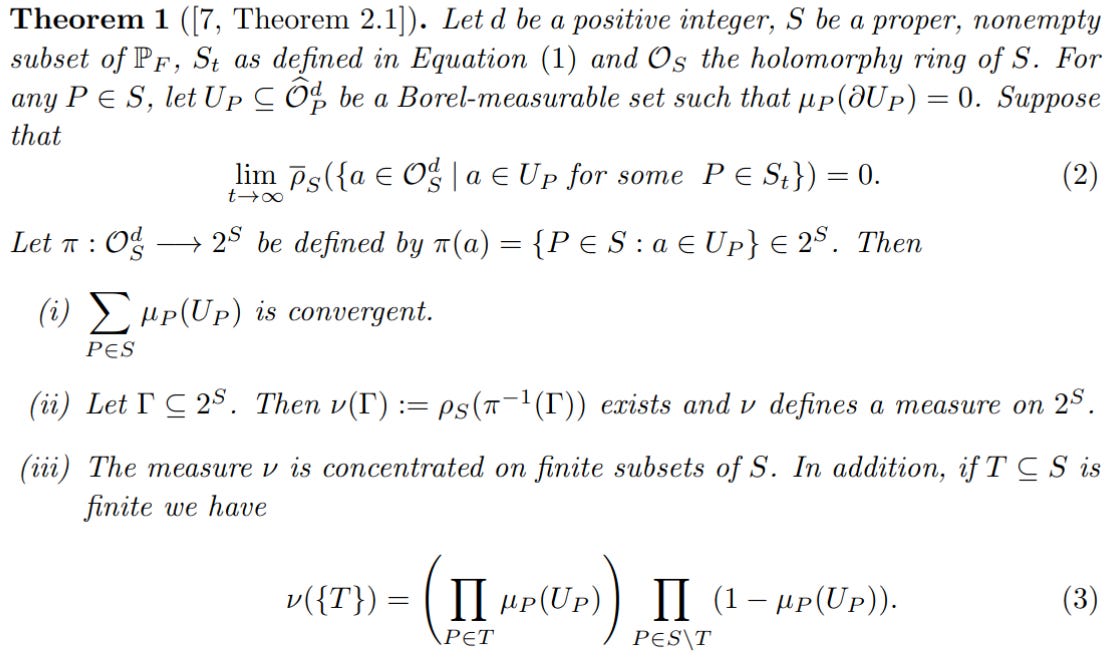
I only focused on understanding what (i) and (ii) say as (iii) seems connected to measure theory but I think I’m too rusty to understand the impact of it.
First to get some notation out of the way, let F be a finite extension of 𝔽ₚ(X) i.e. a global function field (typically global means ℂ, 𝔽ₚ(X), or ℚ). Let 𝒪ₚ be a valuation ring of F with maximal ideal P. P is called a place, and let ℙ_F be the set of all of such places. Then for S a set of places, let 𝒪ₛ be the intersection of all the valuation rings corresponding to each place. If S is the set of all the places, then 𝒪ₛ is like the ring of integers, which is a global object. (these are called the holomorphy rings)
Since F is a global function field, its local fields at a place P (e.g. p-adic fields) have a metric, and hence has a measure associated to it (I think, my measure theory is rusty), call it μₚ. Then ρₛ is a density of primes inside the set function (for the technical definition see the paper). For this, imagine the sieve of Eratosthenes or various lattice points arguments in number theory. Finally, Sₜ is basically telling us that the place needs to be big enough.
Putting everything together, this theorem seems to be saying that given a collection of subsets of d-dimensional local space such that none of them concentrate on the boundary (measure of the boundary) and such that the density of the “union” of them approaches zero as you go further out (t is the going out factor, ρ is the density, and the “union” is a being in one of the Uₚ for a big enough P) various nice things happen. The nice things are:
(i) seems to be saying that the “union” has finite measure. I am not sure how this is supposed to be useful as we should really be caring about density.
(ii) seems to say that the set of places (think a subset of Spec) has a measure!